
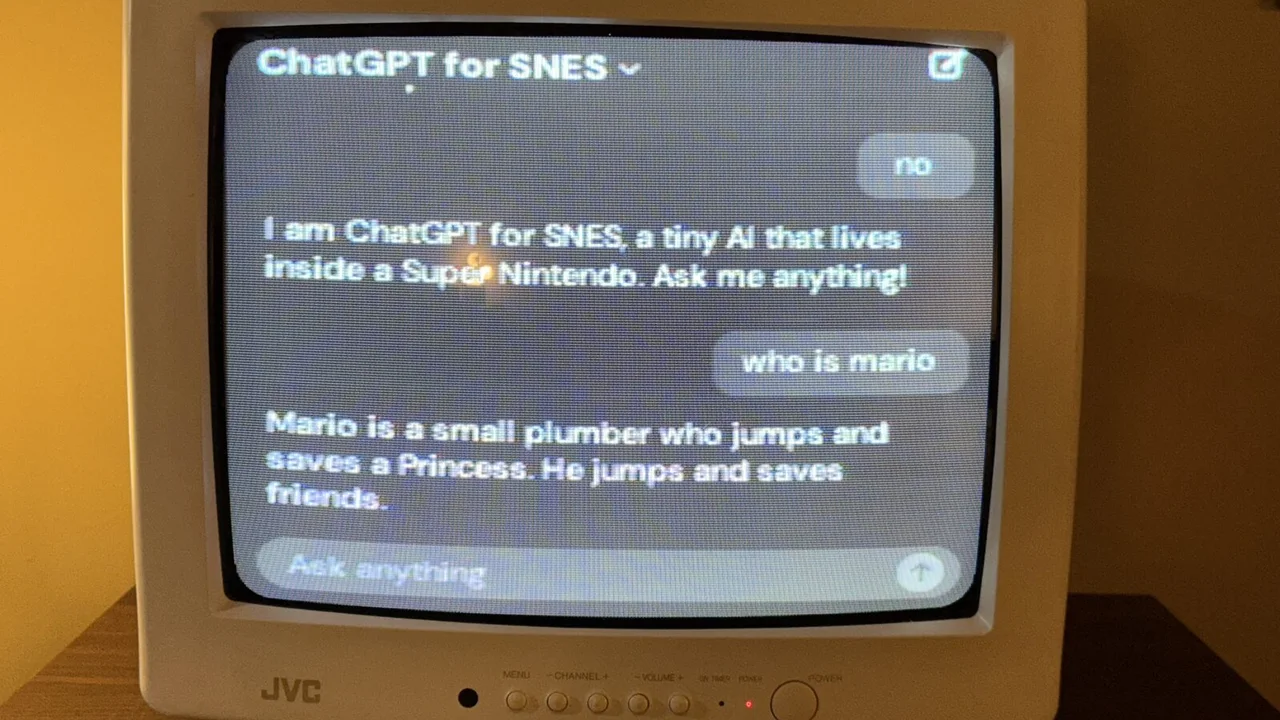
A real AI chatbot running on a 1990 games console sounds like a joke. It isn’t. ChatGPT for SNES is a homebrew cartridge by tech journalist Benj Edwards (BX Foundry), whose latest version, 0.7, came out on 2 November 2026. You type a question with the controller, and a small language model inside the cartridge writes an answer, one word at a time. No internet and no PC: it’s all running on the Super Nintendo.
I was so curious how this could possibly work that we took the ROM apart and studied it. Here’s what’s inside, in plain words.
The short version
- It’s a real language model, just very small. About 2.2 million parameters. The AI behind ChatGPT is millions of times bigger.
- It knows about 8,000 words. Whole words, not word pieces like modern AI uses.
- The heavy maths runs on the Super FX 2 chip. That’s the extra chip inside cartridges like Yoshi’s Island and Doom on SNES. It runs at 21 MHz, and here it’s doing AI maths instead of drawing graphics.
- It was taught by a bigger AI. Its practice conversations were written by OpenAI’s open model, gpt-oss-120b, and the tiny model learned to answer in the same style.
- It runs on real hardware with a flash cart that supports the Super FX (like an FXPak Pro), or in your browser on the BX Foundry site.
Things it actually said
These are real replies we got from the cartridge:
“what is a cat?” “a cat is a small animal. it can be a small hand.”
“hello! who are you?” “I am [its name], a tiny AI that lives inside a Super Nintendo cartridge. ask me anything!”
“tell me a story about a dragon.” “a small dragon lived in a park. a small dragon fell from a garden. it rolled onto a leaf and rested on a forest.”
“what is the moon made of?” “the moon is mostly rock. it has no air, like a moon.”
It gets the idea right surprisingly often, then wanders off in the next sentence. “It can be a small hand” is my favourite. Benj Edwards himself says it often gets things wrong, sometimes confidently, so don’t use it for homework.
How it works (simple version)
Every time it writes a word, the cartridge does the same three steps:
- Read what you typed. Each word you type is looked up in its list of about 8,000 words and turned into a number. If you type a name it doesn’t know, like your own, it saves it in a special “name slot” so it can use it back.
- Think. Those numbers go through 7 layers of maths (the model’s “brain”). Each layer looks back at the earlier words to work out what matters, then mixes that together. This is the part the Super FX 2 chip does, millions of small multiplications per word.
- Pick the next word. The model scores every word it knows, picks one with a little bit of randomness so replies aren’t always the same, prints it, and starts again for the next word.
It keeps going until it picks its “end of reply” word.
The clever tricks that make it fit
A Super Nintendo has 128 KB of memory, and the Super FX was designed in 1993 for 3D graphics, not AI. These are the tricks we found that make it work:
- Small numbers. Normal AI stores its knowledge as precise decimal numbers. This one squeezes most of them into whole numbers from -128 to 127 (8 bits), and the word list into even smaller 4-bit numbers. That’s how about 2.2 million parameters fit on a 2 MB cartridge.
- Two-step word picking. Scoring all 8,000 words for every new word would be too slow. So the words are sorted into 128 groups of 64. The model first picks the most likely group, then picks the word inside it. That’s about 40 times less work than checking every word.
- Skipping the zeros. Inside each layer, lots of the in-between values come out as zero. The code notices and skips them completely, which saves a big chunk of time.
- Sharing the memory parts. The model’s “attention” (how it looks back at earlier words) has 4 heads, but they all share one set of the stored past information instead of each having their own. Less memory, almost the same result.
- Its own random number generator. Small and fast, so the same question can get a different answer each time.
Technical details, for the curious
For anyone who wants the real numbers. These are from our own study of the v0.7 “pure” ROM:
| Cartridge | 2 MB LoROM, Super FX 2 (GSU-2) at 21 MHz, title “CHATGPT FOR SNES” |
| Model | 7-layer transformer, width 128 |
| Attention | 4 query heads of 32, sharing one key head and one value head (grouped-query attention) |
| Feed-forward | 128 → 448 → 128, ReLU, zeros skipped by a sparse kernel |
| Weights | int8 matrices with scaling tables; the word table packed as 4-bit values |
| Vocabulary | 8,157 whole words, plus special tokens for “you”, “AI”, “end of reply” and name slots |
| Tokenizer | a simple hash of each word into a lookup table |
| Output | pick 1 of 128 clusters, then 1 of 64 words inside it |
| Sampling | temperature lookup table plus a 16-bit xorshift random generator |
| Who does what | the SNES’s own CPU handles the keyboard, text and screen; the Super FX does all the model maths |
To check we really understood it, we rebuilt the whole model in Python and ran it side by side with the cartridge in an emulator. Every step matched exactly, and our copy wrote the same replies word for word.
There’s also a second version with a fact book: the opening sentences of 150,000 Simple English Wikipedia articles stored on an MSU-1 data file. The model can decide to “look something up” and print what the book says, a bit like ChatGPT searching the web. It even has a calculator.
Can you try it?
Yes. You can play it in your browser on the BX Foundry site (link below), or download the ROM and run it on a real Super Nintendo with a flash cart that supports the Super FX chip. The fact-book version also needs MSU-1 support.
It isn’t a useful assistant, and it doesn’t pretend to be. But a real language model writing sentences on a Super Nintendo, using a chip family first made for Star Fox, is one of the coolest homebrew projects of the year.
Try it: ChatGPT for SNES on BX Foundry
ChatGPT for SNES is an unofficial experiment by Benj Edwards. It isn’t made or endorsed by OpenAI or Nintendo. We studied the cartridge to explain how it works; we don’t share the ROM or its code. Get it from the official page.


No comments yet. Be the first!